

OSHA Forklift Safety Requirements in 2026
Warehouse Safety & Compliance
How AI Collision Avoidance Helps US Warehouses Stay Compliant
OSHA’s forklift safety requirements, found in 29 CFR 1910.178, call for daily equipment inspections, certified operator training renewed every three years, and documented evaluation of unsafe driving habits. In 2026, OSHA increasingly favors facilities that pair these baseline rules with real-time AI monitoring, since automated collision avoidance and digital inspection logs provide the audit trail inspectors look for.
If you manage a warehouse, distribution center, or manufacturing floor in the United States, you already know forklifts are one of the riskiest pieces of equipment you operate. What’s changing in 2026 isn’t the underlying OSHA rule. It’s how regulators, insurers, and safety teams are starting to evaluate whether you’re actually preventing accidents, not just documenting them after the fact.
This guide breaks down what OSHA’s powered industrial truck standard requires, what it costs you when compliance fails, and where artificial intelligence now fits into a modern safety program. We’ll also walk through how layered technology — AI vision, fleet management, and ground-level impact protection — closes the gap that paperwork alone can’t.
What OSHA Actually Requires Under the Powered Industrial Truck Standard
Forklifts fall under OSHA’s powered industrial truck standard, 29 CFR 1910.178. The rule itself hasn’t been rewritten for 2026, but enforcement attention has sharpened, particularly around documentation and operator accountability. The core requirements are:
- Daily pre-shift inspections. Every powered industrial truck must be checked before each shift, with defects taken out of service immediately.
- Formal operator training and evaluation. Operators need classroom or online instruction, a hands-on practical evaluation, and sign-off before they touch the controls unsupervised.
- Recertification at least every three years. Refresher training is required sooner after an accident, a near miss, an observed unsafe maneuver, or a change in truck type or work conditions.
- Site-specific hazard awareness. Training must cover the actual environment the operator will work in, including ramps, narrow aisles, and pedestrian traffic patterns.
None of this is new. What’s new is that OSHA and liability insurers are now asking facilities to prove these controls are working, not just that a binder of paperwork exists. That’s where the cost data below becomes relevant.
The Real Cost of Forklift Accidents in US Warehouses
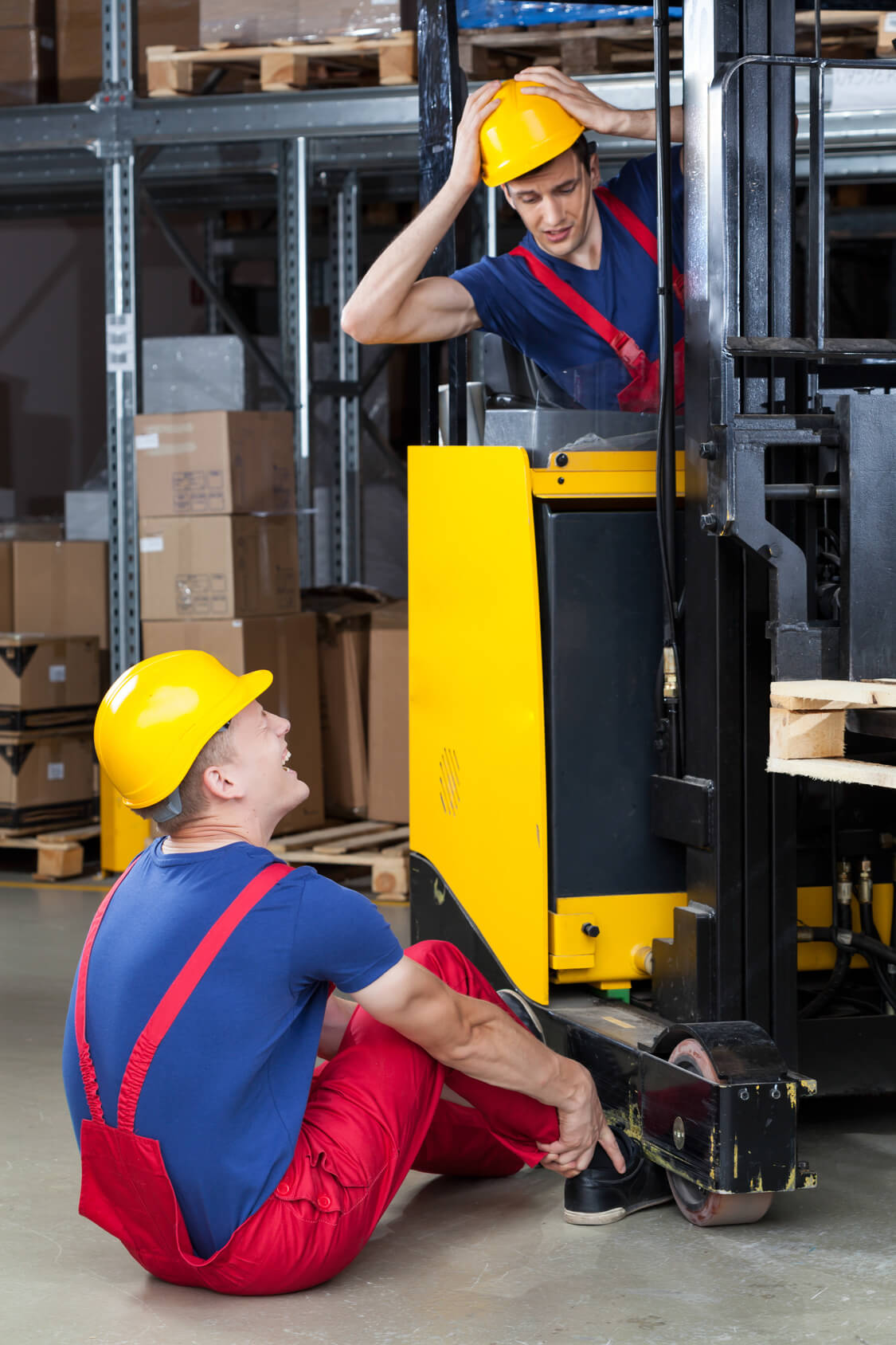
Forklifts move more weight per worker than almost any other piece of warehouse equipment, and the injury data reflects that. The table below summarizes the most recent published figures from OSHA, NIOSH, and the Industrial Truck Association.
| Metric | Figure | Source |
|---|---|---|
| Forklift-related fatalities, per year | ~85 | OSHA |
| Serious injuries, per year | ~34,900 | OSHA |
| Non-serious injuries, per year | ~61,800 | OSHA |
| Fatalities caused by tip-overs | 42% | OSHA |
| Fatalities involving a pedestrian | 36% | OSHA |
| Forklifts in active US use | ~855,900 | Industrial Truck Association |
| Forklifts involved in an accident, per year | ~11% | Industrial Truck Association |
| Immediate annual cost of forklift-pedestrian incidents | $135 million+ | NIOSH |
Figures represent the most recent published estimates available as of this writing and may be revised by the issuing agencies.
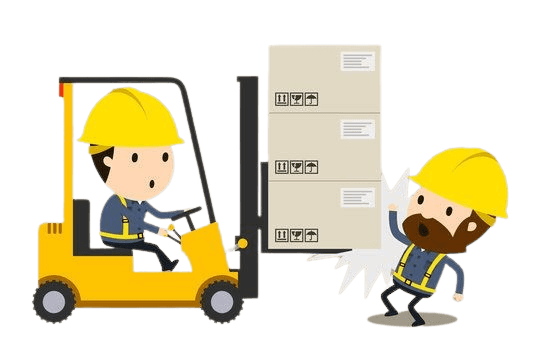
Two numbers stand out for warehouse operators specifically. First, 42% of fatalities come from tip-overs, which are largely a speed and load-handling problem that real-time monitoring can flag before it happens. Second, 36% of fatalities involve pedestrians, which is exactly the scenario passive proximity sensors struggle with most, because they can’t distinguish a person from a parked pallet.
Why Daily Checklists and Telematics Alone Aren’t Enough
Most facilities already run two layers of safety control: the OSHA-mandated daily inspection, and some form of telematics that logs impacts after they happen. Both are necessary. Neither is sufficient on its own.
Telematics tells you a forklift hit a wall. It doesn’t tell you the operator was distracted by a pedestrian stepping out of a blind spot a second earlier. By the time a telematics alert fires, the collision has already occurred. It’s a record-keeping tool, not a prevention tool.
This is the gap AI vision systems are built to close: acting before the impact rather than logging it afterward.
How AI Forklift Safety Systems Close the Compliance Gap
An AI Forklift Safety System uses onboard cameras and neural networks to interpret what’s actually in the forklift’s path, rather than just detecting that something is present. That distinction matters operationally:
- Human-versus-object recognition. The system differentiates a person from a static pallet or rack upright, so it doesn’t fire an alert every time the truck passes a shelf. That cuts the alarm fatigue that makes operators start ignoring basic proximity beepers.
- Sub-second response time. Detection-to-alert (and, where configured, automatic slow-to-stop) typically occurs within 100 to 300 milliseconds, well inside the window where it can still prevent contact.
- 360-degree blind-spot coverage. Loaded forks, mast height, and tight racking all create blind spots a single mirror or backup camera can’t cover. Vision systems are designed to eliminate that gap without adding to the operator’s cognitive load.
- Cloud-logged near misses. Every autonomous stop or near-miss event uploads automatically, giving safety managers a data-backed way to identify “hot zone” intersections and retrain specific drivers before a real accident occurs, not after.
Full Fleet Compliance: Beyond Collision Avoidance
Collision avoidance addresses the moment of impact. A Forklift Management System (FMS) addresses everything around it, the part of compliance that’s easy to lose track of across a multi-shift, multi-plant operation.
Operator authorization
The truck simply won’t start for anyone who isn’t on the authorized, currently certified operator list. This turns the OSHA recertification requirement from a paperwork policy into a hard control enforced at the ignition.
Working time tracking
Accurate logs of actual operating hours per operator support fatigue management and make performance evaluation, a required part of the three-year recertification cycle, far less manual.
Real-time cost visualization
A live dashboard ties maintenance spend, idle time, and utilization to individual units, so safety and finance are working from the same numbers instead of reconciling spreadsheets after the fact.
Pallet counting and reporting
Patented pallet-counting technology adds a productivity layer on top of the safety data, and automated reports flag anomalies, like a sudden spike in hard-braking events on one truck, before they become a pattern.
Ground-Level Risk: Protecting Pedestrians Around Pallet Trucks
Not every incident involves a sit-down forklift. Electric pallet trucks operate at foot level in some of the busiest, most congested areas of a warehouse, dock doors, cross-aisles, and staging lanes, where pedestrian traffic is heaviest.
A rear-mounted pressure-switch solution, such as Teknect’s FootShield Pro, automatically halts a pallet truck the moment it detects an impact or imminent collision, without requiring any change in operator behavior. Because it installs onto standard pallet truck chassis, it’s typically one of the fastest wins a facility can implement before tackling a full sit-down fleet rollout.
Comparing Your Options: Inspection, Telematics, and AI Vision
| Capability | Manual Inspection | Telematics | AI Vision System |
|---|---|---|---|
| Timing of intervention | Pre-shift only | After impact | Before impact (100–300ms) |
| Distinguishes people from objects | No | No | Yes |
| Generates audit-ready data | Paper or manual log | Impact log only | Continuous near-miss + stop log |
| Reduces alarm fatigue | N/A | N/A | Yes |
| Supports OSHA recert evaluation | Partial | Partial | Yes, with operator-level data |
Proven Results From Enterprise Deployments
According to case studies published by Teknect, enterprise fleets running its AI collision avoidance and FMS platform have seen measurable results. AB InBev, the world’s largest brewer, has deployed the system across more than 30 factories. BASF has equipped 487 forklifts with the management system since 2017. Packaging manufacturer Malpack reported a 90% reduction in collisions within a month of its initial trial, and nutrition and materials company DSM reported a significant improvement in forklift safety outcomes after implementation in 2020.
These are vendor-published figures rather than independently audited results, and outcomes will vary by facility layout, fleet size, and how aggressively a site enforces the data the system surfaces. They’re a useful directional signal, not a guarantee.
How to Start a Forklift Safety Compliance Audit
- Pull your last 12 months of incident and near-miss logs. Identify which aisles, dock doors, or shift changes account for the most events.
- Map your “hot zones.” Cross-reference incident locations against pedestrian traffic patterns and blind intersections.
- Pilot AI vision at one or two high-traffic intersections. Measure near-miss and autonomous-stop data over 30 days before deciding on a full rollout.
- Calculate total cost of ownership. Weigh pilot costs against reduced repair spend, downtime, and your facility’s accident-related insurance exposure.
- Scale fleet-wide with operator authorization enabled. Lock in the OSHA recertification control at the ignition level before expanding to additional plants.
See where your facility stands
Teknect’s team can walk through your current inspection and incident data and show where an AI vision pilot would have the fastest impact on safety and TCO.
Request a Facility Assessment →Frequently Asked Questions
What is OSHA’s main forklift safety standard?
OSHA regulates forklifts, officially called powered industrial trucks, under 29 CFR 1910.178. The standard requires daily pre-shift inspections, formal operator training and evaluation, and documented certification before anyone operates a unit.
How often must forklift operators be recertified?
OSHA requires evaluation at least once every three years. Refresher training is required sooner if an operator is involved in an accident or near miss, observed operating unsafely, or moved to a different truck type or environment.
Does AI forklift safety technology replace OSHA-required training?
No. AI collision avoidance and fleet management systems supplement OSHA-required training; they don’t replace it. Facilities still need documented daily inspections and certified operators. AI adds a real-time layer that intervenes when human judgment fails.
How fast can an AI collision avoidance system react compared to a human operator?
AI vision systems typically detect a person and trigger an alert or automatic slow-to-stop within 100 to 300 milliseconds, considerably faster than the second or more it usually takes a human to perceive and react to a sudden hazard.
Can AI safety systems lower forklift insurance premiums?
Some insurers factor documented active safety technology and incident logs into liability pricing for material handling fleets. Confirm specifics with your own carrier, since policies vary.
What’s the difference between passive proximity sensors and AI vision systems?
Passive sensors alert for any nearby object, including pallets and walls, which causes alarm fatigue. AI vision systems use cameras and neural networks to tell the difference between a person and a static object, so they only escalate for genuine hazards.
Key Takeaways
- OSHA’s powered industrial truck standard (29 CFR 1910.178) requires daily inspections, certified operator training, and recertification at least every three years.
- 42% of forklift fatalities involve tip-overs and 36% involve pedestrians, exactly the scenarios real-time AI vision is built to catch before impact.
- Telematics and manual inspections are necessary but reactive; they document what happened after the fact rather than preventing it.
- AI collision avoidance reacts in 100–300 milliseconds, distinguishes people from static objects, and logs every near miss for audit and insurance purposes.
- Operator authorization at the ignition level turns OSHA’s recertification rule into an enforced control, not just a paperwork policy.
