





Industrial Al Vision Safety System
Turn existing CCTV into an active workplace safety network.
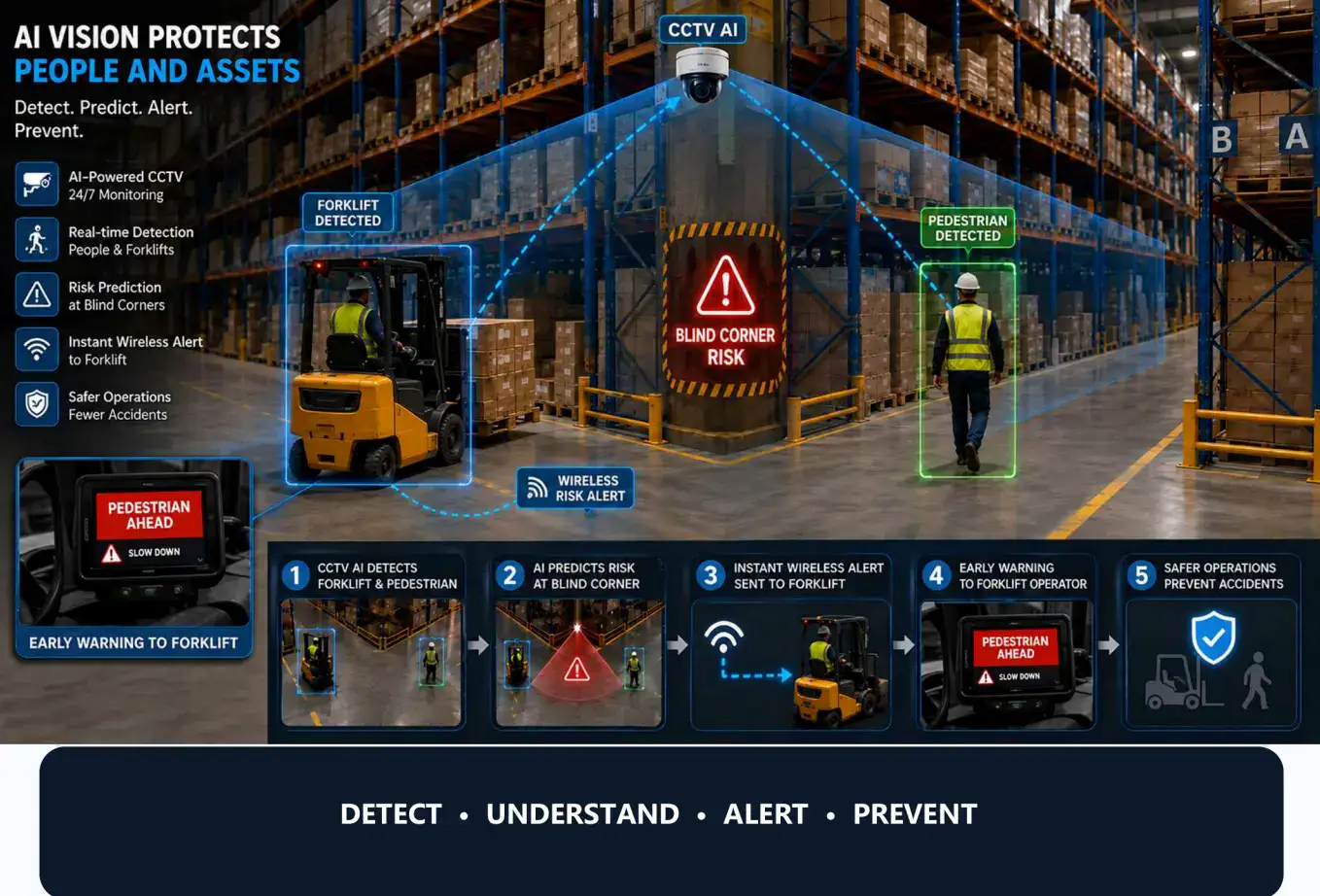
AI-powered safety intelligence for warehouses, factories, distribution centers and industrial operations.
Monitor people, forklifts and safety conditions. Recognize developing risk. Deliver targeted warnings. Turn events into actionable safety insight.
From passive video to active safety intelligence
A flexible platform that adds AI perception, risk awareness and safety workflows to existing CCTV environments.
What the system does
Sees
Detects people, forklifts, PPE and configured safety conditions.
Understands
Tracks movement, zones and developing interactions over time.
Warns
Routes risk alerts to safety teams and, where configured, the specific forklift.
Learns
Turns events into trends, recurring hotspots and preventive actions.
A practical definition
An AI-powered industrial safety system that uses CCTV to monitor workplace risks, identify forklifts and pedestrians, predict hazardous interactions, and provide real-time warnings to help prevent incidents.
Designed around customer outcomes
Earlier awareness
Recognize risks before direct line of sight.
Fewer blind spots
Use elevated CCTV views to complement vehicle-mounted sensing.
Stronger evidence
Capture selected event context for investigation and follow-up.
Better prevention
Use hotspot and trend data to guide corrective action.
One platform for multiple industrial safety risks
Configure use cases by site, area and safety priority.
PPE Compliance
Detect configured missing helmets, vests or other PPE requirements.
Restricted Zones
Identify people or vehicles entering defined high-risk or restricted areas.
Forklift & Pedestrian
Monitor vehicle-pedestrian interaction across shared work areas.
Blind-Corner Risk
Recognize developing conflicts before driver and pedestrian have direct sight.
Near-Miss Capture
Capture selected high-risk interactions for coaching and prevention.
Walkway / Exit
Identify configured obstructions or unsafe occupancy conditions.
Person-Down
Support detection of abnormal person-down situations where applicable.
Safety Analytics
Highlight recurring locations, patterns and risk concentrations.
See beyond the blind corner
CCTV can provide a wider field of view and send an earlier warning to the vehicle involved.
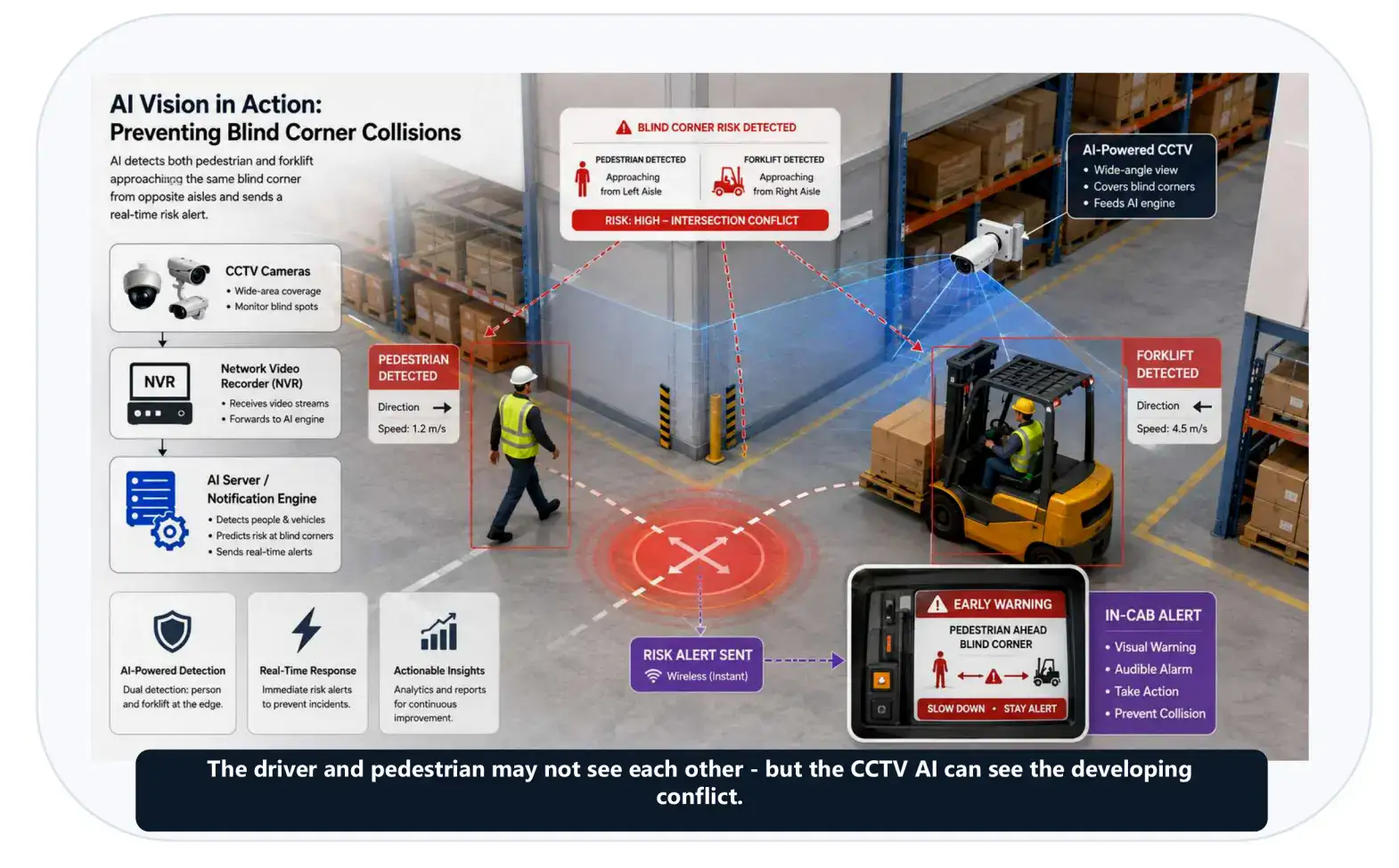
The driver and pedestrian may not see each other – but the CCTV AI can see the developing conflict.
How the warning works
Detect both subjects
CCTV AI identifies the forklift and pedestrian.
Recognize conflict
The system identifies a developing blind-corner risk.
Send targeted warning
A wireless alert is sent to the specific forklift.
Act earlier
The operator receives an early warning before direct visual contact.
Simple for users. Powerful behind the scenes.
The customer sees one connected safety process rather than a collection of separate technologies.
EXISTING CCTV
Provides site-wide visual coverage
AI SAFETY INTELLIGENCE
Detects and interprets configured safety events
RISK AWARENESS
Prioritizes events that may require action
SAFETY RESPONSE
Warnings, dashboard events and follow-up
Configurable response options
Forklift warning
Targeted real-time alert to the vehicle involved.
Safety notification
Alert supervisors or designated safety contacts.
Dashboard event
Create a searchable record for review and analytics.
Local alarm
Optional area warning for selected high-risk zones.
A safer site starts with better visibility.
Use existing camera coverage to gain earlier risk awareness, faster response and stronger safety insight.
Customer value
Leverage existing infrastructure
Reduce the need for entirely new sensing infrastructure where CCTV coverage is suitable.
Improve blind-area awareness
Use higher vantage points to complement the driver’s line of sight.
Connect awareness to action
Deliver the risk to the people or forklift that can respond.
Build a prevention data set
Use events, trends and hotspots to support continuous improvement.
Recommended next step: focused site pilot
Select priority cameras, risk zones and forklift interactions – validate performance, then scale.
Feature availability and performance depend on selected configuration, site conditions and validation.