

The Morning I Stopped Fighting My Own Warehouse
The Morning I Stopped Fighting My Own Warehouse
How connected forklift safety technology changed everyday warehouse management — one safety manager’s account of what happened when the shop floor finally caught up with the paperwork.
The Whiteboard
I remember the whiteboard.
Every Monday, marker in hand, I’d try to reconstruct the previous week from memory, paper inspection sheets, and whatever incident reports had actually made it to my desk. Near-misses that went unlogged. A “dangerous-feeling” pedestrian zone with no data behind the feeling. A driver flagged twice for speeding — but nothing connected until something actually happened.
That was the job: reacting to yesterday’s problem with tomorrow’s memo. The gap between having a policy and knowing what’s really happening on the floor — that’s where every incident I ever investigated actually started.
This is the story of how that gap closed, and what forklift safety, compliance, and fleet management actually look like once a warehouse becomes connected.
Why the Old Safety Model Kept Failing
Warehouses didn’t get more dangerous over the years — they got more complex. More SKUs, more shifts, tighter delivery windows, contract drivers rotating through, and the same forklifts moving faster through the same narrow aisles.
Under the old model, three things quietly broke down:
| Old Model | What Actually Happened |
|---|---|
| Compliance | Became a paperwork exercise, reviewed only during audits — not a live picture of daily risk |
| Inspections | A start-of-shift checkbox on a clipboard, not a continuously verified state |
| Driver Behavior | The single biggest variable in every incident report, yet completely invisible until something went wrong |
The underlying problem was simple to state and hard to fix: you cannot manage what you cannot see.
Three Warehouse Scenarios Every Safety Manager Recognizes
The Blind Corner Near Receiving
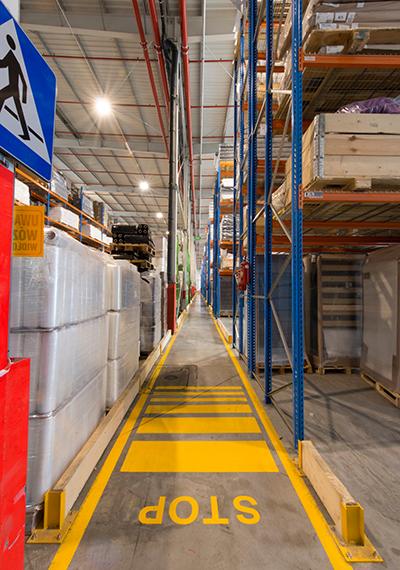
A pedestrian walkway crosses a high-traffic forklift route near the dock. No formal incident on record — but every supervisor privately routes around it. No data means no case for redesign, until a near-miss forces one.
What changes: AI vision logs every close-approach event automatically, turning a gut feeling into a timestamped, heat-mapped risk zone.
The Repeat Offender Nobody Connected
One supervisor flags a driver for speeding in Aisle 3. A different supervisor flags the same driver for a hard stop two weeks later. Different notebooks, no pattern — until a third event causes real damage.
What changes: Every flagged event attaches to the operator’s ID fleet-wide, so the second flag surfaces the first — before event three.
The Inspection That Wasn’t
A forklift with a slow hydraulic leak passes a rushed pre-shift check because the sheet gets signed out of habit, not verification. It runs two more shifts before the leak becomes a failure.
What changes: Digital inspection timestamps and routes every defect the moment it’s logged — no more “probably fine.”
How Connected Systems Changed What “Seeing” Means
Safety stopped being a paper trail and became a live feed. Here’s what that looks like system by system:
| System | What It Replaces | What It Delivers |
|---|---|---|
| AI Anti-Collision (TK300) | Manual horns, painted floor lines, reaction time | Automated zoning, early detection, auto slow-to-safe-stop |
| Fleet Management (FMS) | Spreadsheets, radio check-ins, weekly reports | One live dashboard for location, utilization, maintenance, alerts |
| Driver Monitoring (DMS) | Supervisor memory, verbal warnings | Real-time fatigue and unsafe-behavior flags tied to a driver ID |
| Digital Inspections (doCheck) | Paper checklists, eyeballed walkarounds | Timestamped, routed defect logging with a built-in audit trail |
| Load & Speed Control (LP-S1) | Operator judgment under time pressure | Enforced limits before a tip-over or overload threshold |
| AI Vision / Pedestrian Detection | Convex mirrors, painted lines, hope | Reliable blind-corner detection independent of sightlines |
What Changed for Me as a Safety Manager
No more whiteboard. I start the day with a dashboard that already knows where the risk is.
- Compliance is continuously documented, not chased at audit time.
- Inspections are a verified data point, not a matter of trust.
- Driver behavior is visible in real time, not reconstructed from memory.
- Leadership conversations run on a connected incident trend line going down — not a values argument.
Technology didn’t replace my judgment as a safety manager. It finally gave that judgment something real to work with.
Frequently Asked Questions
What is a forklift anti-collision system?
A forklift anti-collision system uses sensors, cameras, or UWB technology to detect pedestrians and other vehicles in real time, automatically warning the driver or slowing the truck to prevent a collision — without relying solely on operator reaction time.
How does a fleet management system improve warehouse safety?
A fleet management system centralizes forklift location, utilization, maintenance status, and safety alerts on one live dashboard, allowing safety managers to identify and respond to risks as they happen rather than after an incident report is filed.
Why does digital inspection matter more than paper checklists?
Digital inspection tools timestamp and route every reported defect instantly, creating a verifiable compliance trail and removing the risk of a rushed or skipped paper inspection going unnoticed.
Can driver monitoring technology reduce repeat safety incidents?
Yes. By tying every flagged event — speeding, fatigue, hard stops — to a single driver ID across the entire fleet, patterns that used to go unnoticed across different supervisors and shifts become visible early enough to intervene.
Ready to Move From Paperwork to a Connected Warehouse?
If you’re a safety or operations leader still running your floor off memory, spreadsheets, and paper checklists, let’s compare notes. Teknect.ai builds connected forklift safety systems — anti-collision, fleet management, driver monitoring, digital inspections, and load control — designed for warehouses that need real-time visibility, not end-of-week reconstruction.
Get in touch — sales@teknect.ai