




AI Replacing Forklift Operators — or Giving Them a Co-Pilot?
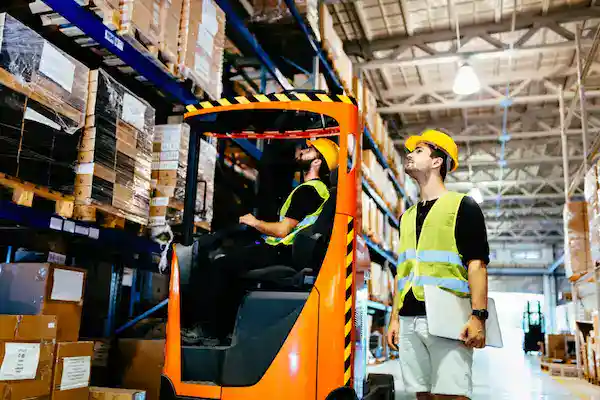
Is AI Replacing Forklift Operators — or Finally Giving Them a Co-Pilot?
I have spent over fifteen years walking concrete floors in high-throughput distribution hubs and manufacturing plants. During that time, I developed a healthy skepticism toward any tech vendor promising a silver bullet to “solve” workplace safety.
When industry discussions frame AI material handling as a binary choice—total warehouse automation versus the status quo—they ignore operational reality. The question EHS leaders need answered is simple: what technology is actively preventing recordables and near misses on the floor right now? The data confirms that human-machine co-pilots, not full replacement, represent the decisive safety leap.
The Forklift Safety Baseline: Why Numbers Have Stagnated
Before assessing next-generation hardware, safety leaders must confront industrial realities. Decades of floor striping, convex mirrors, spotter policies, and operator recertifications have hit a performance plateau.
| Metric Benchmark | Annual Industrial Impact | Primary Regulatory Source |
|---|---|---|
| Fatalities | 84 annual worker fatalities involving lift trucks | BLS / NSC Injury Facts |
| DART Cases | 25,110 cases (including 15,460 days-away-from-work) | BLS Survey of Occupational Injuries |
| Severe Injuries | 1,190 severe events (994 inpatient hospitalizations, 196 amputations) | OSHA Severe Injury Reports |
| OSHA Citations | 2,248 citations; Top-10 cited standard list (29 CFR 1910.178) | OSHA Enforcement FY2024–FY2025 |
-
Pedestrian Strikes Remain Fatal: Struck-by incidents involving pedestrians continue to serve as the single leading cause of lift truck fatalities across material handling.
-
Decade-Long Plateau: Workplace fatality counts have hovered stubbornly between 65 and 85 deaths per year for more than ten years.
-
Persistent Top-10 Violations: Powered Industrial Trucks (29 CFR 1910.178) consistently ranks among OSHA’s most frequently cited standards nationwide.
Training, signage, and punitive supervision have taken facilities as far as humanly possible. The next breakthrough requires intelligent, automated intervention at the millisecond level.

The Automation Trap: Why Lights-Out Warehousing Remains Niche
Walk through any supply chain expo and you will encounter autonomous forklifts running smooth laps around pristine, barricaded exhibition pens. It is a compelling vision, but it does not reflect the daily grind of an active facility.
Fully autonomous lift trucks thrive under rigid, highly engineered parameters:
-
Fixed Transit Corridors: Engineered, unvarying routes that cannot tolerate sudden operational deviations.
-
Predictable Pallet Positions: Uniform dimensions, non-damaged pallets, and perfect racking alignment.
-
Physical Segregation: Complete segregation from foot traffic and manually driven mixed fleets.
The facilities running real-world supply chains look nothing like that. They balance mixed truck fleets, seasonal temporary laborers, cross-dock congestion, unannounced contractors, and workers taking shortcuts. That dynamic, messy environment is precisely where collisions take place—and it is where autonomous robotics struggle most. Autonomy is coming, but for most facilities, it remains a long-term capital horizon.
The Co-Pilot Solution: Augmenting the Operator
Aviation offers the gold standard for operator safety. Commercial airlines did not eliminate pilots when computer flight controls arrived. Instead, aviation engineers surrounded flight crews with multi-layered telemetry: terrain awareness, mid-air collision avoidance (TCAS), and fly-by-wire limiters. Augmentation turned aviation into the safest transportation mode in modern history.
1. Vision-Based Pedestrian Detection
Edge-computed optical AI identifies human silhouettes, limbs, and postures in milliseconds—eliminating nuisance false alarms common to basic ultrasonic proximity sensors.
2. Automated Speed Governing
The truck actively limits speed in blind spots, congested intersections, and pedestrian crossings—enforced reliably by the machine rather than memory.
3. Driver Monitoring Systems (DMS)
In-cab optical sensors flag phone use, microsleeps, and distraction before they turn into critical near-misses or catastrophic collisions.
4. Tamper-Proof Digital Inspections
Time-stamped, paperless pre-shift checklists tied to operator credentials and machine interlocks eliminate pencil-whipping entirely.
5. Real-Time Fleet Intelligence & Leading Indicators
Converts instant floor alerts into predictive telematics, plotting pedestrian risk heatmaps and tracking shift-level compliance instead of waiting on post-accident investigations.

Full Automation vs. AI Co-Pilot: Head-to-Head Comparison
For operations directors balancing capital expenditures with safety benchmarks, here is how both technologies compare on the floor:
| Operational Consideration | Full Automation (AGV / AMR) | AI Co-Pilot Retrofit (e.g., TK300) |
|---|---|---|
| Deployment & Fleet Compatibility | Requires purchasing new, bespoke robotic units | Retrofits on existing fleets in hours (Gas, Diesel, Electric) |
| Facility Infrastructure | Extensive redesign, QR striping, physical barriers | Zero facility restructuring; adapts to existing layouts |
| Operating Environment | Structured, fixed-route, highly predictable corridors | Mixed fleet, dynamic cross-docks, seasonal labor traffic |
| Operator Role | Displaced / Shifted to centralized monitoring consoles | Retained; human judgment backstopped by machine vision |
| Data Output | Route throughput, vehicle battery telemetry, uptime | Near-miss density, speed compliance, pedestrian heat maps |
| Time to Measurable ROI | Years (typically 24 to 48 months) | Immediate first quarter (30 to 90 days) |
Three Strategic Advantages for Safety Executives
If you are building a business case for executive leadership, anchor your proposal around these three operational fundamentals:

The Field Caveats — Stated Plainly
Technology introduced onto a broken safety foundation will fail. EHS leaders must implement systems with clear operational boundaries:
-
Not a Training Replacement: A co-pilot is not a substitute for hands-on driver education, physical guardrails, and rigorous supervision.
-
Culture Dictates Efficacy: Layering cameras over unreasonable production quotas merely generates alarm fatigue, not improved safety scores.
-
Environmental Constraints: No camera system performs identically across extreme lighting glare, heavy dust, or condensation without proper industrial ratings and lens maintenance.
Where I Have Landed
The question was never “human or machine.” The real question is: what does the machine do at the moment the human is most vulnerable?
An AI co-pilot answers that question every shift, on trucks you already own, with the operators you already employ. Full automation may be the eventual destination, but AI as a co-pilot is the road—and it is open today.
Frequently Asked Questions (FAQ)
-
What is an AI forklift co-pilot?
An AI forklift co-pilot is a retrofit operator-assist platform that pairs vision-based pedestrian detection, automatic speed control, in-cab driver monitoring, and fleet telematics to safeguard the driver without replacing them. -
How does vision-based anti-collision differ from legacy proximity sensors?
Legacy proximity and RFID systems trigger on any obstacle or require workers to wear transponders, causing constant false alarms near racking. Vision-based AI actively recognizes human form and posture, providing targeted alerts only when a person is in hazard path. -
Can AI safety systems be installed on an existing forklift fleet?
Yes. Platforms like the Teknect TK300 AI Anti-Collision and Driver Monitoring System are universal retrofits compatible with electric, LPG, and diesel lift trucks across all major equipment manufacturers. -
What leading indicators can a forklift fleet management system provide?
Leading telemetry includes near-miss counts by warehouse zone, shift speed compliance rates, operator fatigue/cell phone distraction alerts, and digital pre-shift inspection records.
Evaluating AI Forklift Safety Technology?
Teknect.ai works alongside safety, operations, and fleet leaders to deploy vision-based anti-collision, driver monitoring, and fleet intelligence across mixed-fleet environments. Build your proactive safety business case today.
Schedule a Fleet Assessment